Tickets on sale! September 22st – September 24th Buy ticket now
Think of it like this: Imagine you’re lost in the desert, desperately thirsty. Suddenly, someone offers you a bottle of water. Does it matter if that person hurt you before? Does it matter if the water might be poisoned? Your survival instincts are screaming ‘DRINK!’ That’s exactly what’s happening in your brain right now.  This is where trauma bonding comes into play, and it’s more sinister than most people realize. Every time they hurt you and then comforted you, they weren’t just manipulating your emotions — they were literally rewiring your brain. You became addicted not just to them, but to the cycle of pain and relief.
AI generated image @ Bing

Think of it like this: Imagine you’re lost in the desert, desperately thirsty. Suddenly, someone offers you a bottle of water. Does it matter if that person hurt you before? Does it matter if the water might be poisoned? Your survival instincts are screaming ‘DRINK!’ That’s exactly what’s happening in your brain right now.

This is where trauma bonding comes into play, and it’s more sinister than most people realize. Every time they hurt you and then comforted you, they weren’t just manipulating your emotions — they were literally rewiring your brain. You became addicted not just to them, but to the cycle of pain and relief.

You may also like

What society thinks recovering from sexual violence involves:

  • learning to have sex again

What recovery from sexual violence really involves:

  • learning to breathe without panicking

  • learning to exercise again

  • Learning to trust again

  • Healing the physical injuries from the attack

  • Healing the emotional pain

  • Learning who will stand with you as you remake your life

  • Grieving the people who let you down

  • Remaking a new relationship with your body

  • Learning to dress your body in a way that helps you feel safe

  • Learning to sleep through the night again

  • Developing a new worldview that incorporates the horrific things you've learned humans inflict on each other

And so, so, so many other things.

Sexual trauma impacts every aspect of the survivor's life. No-one should have to recover alone.

Jan 24. 2025
Intro Image

As Kay Wilson struggled to make her way through a Jerusalem forest after being repeatedly stabbed by a Palestinian terrorist, she distracted herself from her agony by playing the song "Somewhere Over the Rainbow" in her mind, composing a new piano arrangement while she fought for breath and forced herself to put one bare foot in front of the other.

Wilson, then 46, had been working as a tour guide when, on Dec. 18, 2010, she and a friend were ambushed by terrorists. Wilson witnessed her friend's murder and was herself viciously stabbed with a machete, ultimately playing dead as her attacker plunged his knife into her chest a final time.

She eventually recovered from her severe physical wounds and is healing from her psychological trauma. She now speaks to global audiences about her survival, hoping to "dispel hatred, whether toward Arabs or Jews."

The work "helps me make meaning out of something so senseless," says Wilson, who is also writing a book about her experiences.

After the attack, Wilson had flashbacks and deep survivor's guilt. But like many people who have survived trauma, she has found positive change as well—a new appreciation for life, a newfound sense of personal strength and a new focus on helping others.

Post-traumatic growth (PTG) is a theory that explains this kind of transformation following trauma. It was developed by psychologists Richard Tedeschi, PhD, and Lawrence Calhoun, PhD, in the mid-1990s, and holds that people who endure psychological struggle following adversity can often see positive growth afterward.

"People develop new understandings of themselves, the world they live in, how to relate to other people, the kind of future they might have and a better understanding of how to live life," says Tedeschi.

How can clinicians use PTG theory to help patients? How has new research helped refine understanding of it? Here's a look at developments in the field.

Signs of post-traumatic growth

PTG can be confused with resilience, but the two are different constructs (see "The post-traumatic growth inventory" below).

"PTG is sometimes considered synonymous with resilience because becoming more resilient as a result of struggle with trauma can be an example of PTG—but PTG is different from resilience, says Kanako Taku, PhD, associate professor of psychology at Oakland University, who has both researched PTG and experienced it as a survivor of the 1995 Kobe earthquake in Japan.

"Resiliency is the personal attribute or ability to bounce back," says Taku. PTG, on the other hand, refers to what can happen when someone who has difficulty bouncing back experiences a traumatic event that challenges his or her core beliefs, endures psychological struggle (even a mental illness such as post-traumatic stress disorder), and then ultimately finds a sense of personal growth. It's a process that "takes a lot of time, energy and struggle," Taku says.

Someone who is already resilient when trauma occurs won't experience PTG because a resilient person isn't rocked to the core by an event and doesn't have to seek a new belief system, explains Tedeschi. Less resilient people, on the other hand, may go through distress and confusion as they try to understand why this terrible thing happened to them and what it means for their world view.

To evaluate whether and to what extent someone has achieved growth after a trauma, psychologists use a variety of self-report scales. One that was developed by Tedeschi and Calhoun is the Post-Traumatic Growth Inventory (PTGI) (Journal of Traumatic Stress, 1996). It looks for positive responses in five areas:

  • Appreciation of life.
  • Relationships with others.
  • New possibilities in life.
  • Personal strength.
  • Spiritual change.

The scale is being revised to add new items that will expand the "spiritual change" domain, says Tedeschi. This is being done "to incorporate more existential themes that should resonate with those who are more secular" as well as reflect cross-cultural differences in perceptions of spirituality.

A predisposition for growth?

How many people experience PTG? Tedeschi prefers not to put a hard number on it.

"It all depends on the trauma, the circumstances, the timing of the measurement … [and] on how you define growth using the PTGI, looking at total score, means, factors or individual items," he says. However, he estimates that about one-half to two-thirds of people show PTG.

Some PTG researchers have tried to corroborate self-­reported growth by questioning friends and family members about whether growth "sticks."

"We are getting more studies that show that PTG is generally stable over time, with a few people showing increases and a few showing decreases," Tedeschi says. "It is now up to us to learn what is going on with those who change over time, but the evidence is for stability in general, and also corroboration by others."
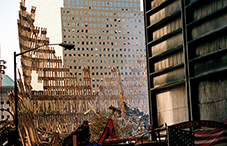
Growth after trauma There appear to be two traits that make some more likely to experience PTG, says Tedeschi: openness to experience and extraversion. That's because people who are more open are more likely to reconsider their belief systems, says Tedeschi, and extroverts are more likely to be more active in response to trauma and seek out connections with others.

Women also tend to report more growth than men, says Tedeschi, but the difference is relatively small.

Age also can be a factor, with children under 8 less likely to have the cognitive capacity to experience PTG, while those in late adolescence and early adulthood—who may already be trying to determine their world view—are more open to the type of change that such growth reflects, says Tedeschi.

There also may be genetic underpinnings for PTG, but researchers are just beginning to tease this out. In a 2014 study in the Journal of Affective Disorders, for example, Harvard social and psychiatric epidemiologist Erin Dunn, ScD, and a team of researchers examined data previously collected from over 200 Hurricane Katrina survivors and found that variants in the gene RGS2 significantly interacted with levels of exposure to the hurricane to predict PTG. RGS2 is linked to fear-related disorders, such as post-traumatic stress disorder, panic disorder and anxiety.

Dunn calls the results "very interesting" but notes that "we have to be somewhat cautious in interpreting it because we were unable to find a similar sample to replicate that finding."

Sarah Lowe, PhD, of Montclair State University, who worked with Dunn on the research, says one difficulty with gene studies for PTG is the concept's complexity. "If you look at what predicts PTG, it is often psychological stress and dysfunction—but also more positive personality traits like optimism and future orientation, which you'd expect would have a very different genetic basis," she says.

Theory into practice

Is it possible to prepare people for PTG, to pave the way should tragedy or trauma strike? Yes, says Tedeschi, noting that psychologists can "allow people to understand that this may be a possibility for themselves" and is a "fairly normal process" if and when trauma occurs.

More often, though, therapists will become involved not before adversity has occurred, but afterward. In this context, they can introduce PTG concepts but need to take care doing so.

H'Sien Hayward, PhD, cautions that therapists should not "jump right into the possibility of growth," which she says can "often be construed as minimizing someone's pain and suffering and minimizing the impact of the loss."

Hayward, who works with veterans at VA Long Beach Medical Center in Long Beach, California, knows about such growth firsthand: She was paralyzed in a car accident when she was 16, ending a competitive athletic career. She overcame that trauma through the help of supportive family and friends, went on to study social psychology at Harvard and has traveled to more than 42 countries, often on humanitarian missions providing counseling and other support to trauma victims. Today, she credits the accident for increasing her strength of character "exponentially" by forcing her to overcome challenges. She also appreciates life and relationships with others—including the near-daily support in the small tasks of daily living that she gets from friends and strangers alike: "those interactions warm my heart."

Yet Hayward is careful not to preach the potential for upside to her patients before they are ready. Instead, she waits for them to express "some positive reaction to the event."

She also helps patients discover what's meaningful in their lives and then helps them schedule activities involving these interests, such as spending more time with family members or doing volunteer work.

Tedeschi says sometimes traditional therapy for trauma patients gives people short-fix solutions to help them resume daily functions, such as sleep or work, but may not provide them with a way of living "beyond just getting by .... We've got to attend to their experience of life and how meaningful, satisfied and fulfilling it is."

One veterans' care facility that takes a nontraditional, PTG approach to trauma treatment is Boulder Crest Retreat in Bluemont, Virginia. The private, donor-supported institute provides free, weeklong nonclinical exercises and activities for vets seeking recovery from combat stress. The treatment is led primarily by veterans who have themselves gone through trauma and achieved growth. Vets are encouraged to deal with past traumas while also discovering their underlying strengths, as well as forging connections with others and ultimately finding ways to give back.

After the intensive program, vets are followed for 18 months with regular Skype check-ins.

Kevin Sakaki, a former Marine and intelligence/special operations veteran, entered Boulder Crest's Warrior program last September and found it transformative. He's noticed such changes in himself as better communication with his family, less anger ("Things don't get to me as much"), a deeper appreciation of "the little things," more generosity and a stronger connection to other people.

Tedeschi is among the psychologists studying the Boulder Crest program's efficacy as part of a research grant funded by the Marcus Foundation.

He hopes that as vets go through the process at Boulder Crest, they "develop new principles for living that involve altruistic behavior, having a mission in life and purpose that goes beyond oneself, so that trauma is transformed into something that's useful not only for oneself but for others."


The post-traumatic growth inventory

To evaluate whether and to what extent someone has achieved growth after a trauma, psychologists look for positive responses in five areas.

1: Appreciation of life

2: Relationships with others

3: New possibilities in life

4: Personal strength

5: Spiritual change

Source: Richard Tedeschi, PhD, and Lawrence Calhoun, PhD, Journal of Traumatic Stress, 1996

Jan 31. 2025
Intro Image

Because my husband died very close to the beginning of January, since 2022 I’ve measured time by Years of Widowhood, rather than calendar years.1 Around the New Year period, my reflections on the past twelve months now tend to be reflections on each foregoing stage of loss, rather than on the broader personal and social milestones of the previous year. This is a largely I-oriented post in which I’m trying to capture the often nebulous ways in which my experiences of widowhood and grief have changed over time. These notes are partly for myself, but I hope that these reflections might be helpful to other bereaved people - especially those in the early stages - and to those supporting them.

Year 1

Soon after Pete died in January 2022, I joined a community called Widowed and Young (WAY), and posted on its online chat forum, ‘how long does this pain last’? With an ultra-runner’s mindset, I wanted to pace myself; to ready myself for X months of agony - so long as there was the assurance of some rest and recuperation at the end of it. Unsurprisingly, no-one was able to give me a schedule for grief. But elsewhere, I read about other women who had been widowed through suicide, and how they described that the first year was largely characterised by shock, and that the actual work of mourning didn’t really begin until year two. In retrospect, I would largely agree with this.

Year 1, 2022, was a year in which, although I knew on a conscious level that Pete had died, my unconscious was slow to catch up. Especially in the early months, each day involved hundreds of ‘coming to’ moments. You know how, when something good and unexpected happens - like winning a prize, or being offered a new job - and the following morning you have a delicious split second when you remember the good thing all over again, and it’s almost as good as when you first learned about it? Well, bereavement involves millions of examples of the inverse of such moments. Every time I thought about something else other than Pete’s death for an instant, it was followed by a horrific jolt of awakening, and realising, all over again, that ‘fuck, he’s dead’; and each of these ‘coming to’ moments was almost as painful and shocking as the first time I learned that he had died. With each realisation, I sobbed, or doubled over, or experienced absences in which I found myself stopping stock still and staring into space for minutes at a time. I think that perhaps a person has to endure millions of these horrible awakenings - both in waking life, and in dream life, in which I dreamed variations of the exact same dream for nearly 2 years - in order to truly believe that the death has occurred; in order to feel that it’s true on a level that is more profound than simply, rationally, logically, being able to say that it’s happened.

Joan Didion famously wrote about how the first year after the sudden, shocking loss of a life partner is a ‘year of magical thinking’. Living through a period in which your life has drastically, irrevocably changed, but in which you haven’t quite absorbed it as true, can indeed involve some pretty illogical thoughts and behaviour. I longed for physical pain to replace the grief and contemplated smashing my legs with a hammer. I felt the horror of it all like millions of insects crawling over my skin, and hacked off my hair to get rid of them. I thought that I was haemorrhaging from my stomach and was confused that no-one else could see it. I worried that the police were mistaken and that it wasn’t Pete who was dead, but a mugger who had stolen his wallet. When the police returned Pete’s belongings to me, I fretted about how he was going to get back into the house without his keys. It took a long time to stop expecting to see Pete walking towards the house when I heard a car pull up on the driveway; and occasionally I still, even now, find myself reaching for my phone to text him when one of our daughters does well in a school assignment. As I’ve said, intellectually, consciously, rationally, I knew straight away that he had died and wasn’t coming back, but it took about a year for the rest of me to catch up. And the awful madness of that first year was compounded by the fact that I found myself embroiled in extremely strange activities, such as choosing a burial plot for the man who had, just a few days earlier, been sleeping beside me, and dealing with other people - lawyers, in-laws, and names I only dimly knew from Twitter - who were also behaving extremely strangely.

Year 2

Year 2 introduced a very different kind of mourning. The early part of the year was still dominated by madness, exacerbated by anticipation of the imminent publication of my book In Her Nature, the majority of which I’d written in the Before Times. I had changed in the time between writing and publication, and it was odd to be attached to a relic of a past self whom I barely even recognised. The bitterness of my bittersweet feelings about my book was intensified when an ex-colleague tried to halt its publication. But by Easter of that year, the book was out and most of the mad activities in which I’d been engaged since Pete’s death - court cases, financial wrangles, the inquest, probate, the ex-colleague’s dispute - were largely over; or, at least, my involvement in them was. By the summer, I had realised that, for a host of reasons, a return to my full-time academic job was untenable. So, halfway through Year 2, and eighteen months since Pete’s death, I finally entered a period of relative stillness, in which I truly believed he was dead, and in which the skeleton outlines of my new life were pencilled in and unlikely to undergo further drastic change. And this is when I really started to take stock of the numerous ways in which my life had been decimated, and started to feel that I had lost everything.

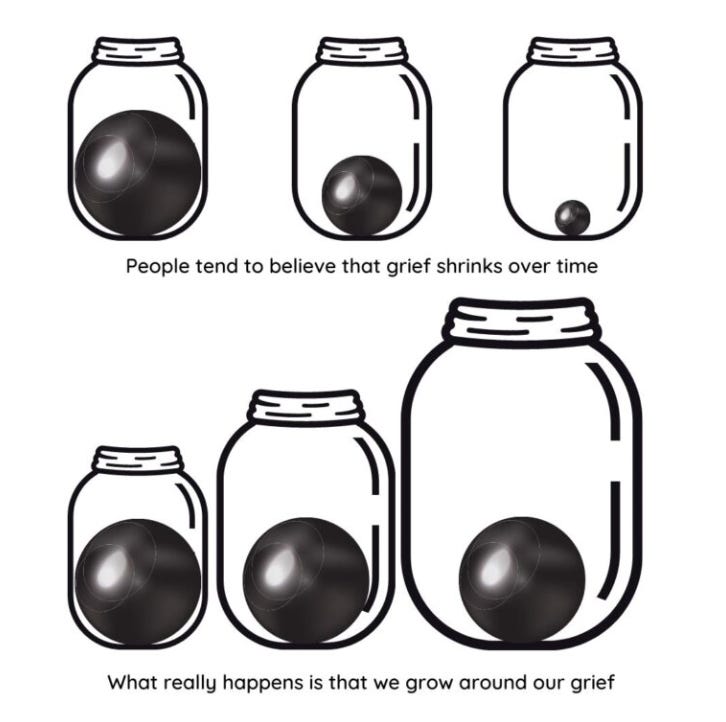
Recently, I’ve been reading a little about ‘post-traumatic growth’, a term which psychologists use to refer to how some people experience profound and often positive change after trauma. I have to admit that when I first heard the term, my hackles raised. It reminded me of how certain friends and acquaintances of bereaved people have a tendency to diminish the magnitude of loss, largely to make themselves feel better: ‘you’re so strong; you’ll weather this’; ‘at least you have your children/house/writing’.2 There is an image that is well-known to bereaved people, in which the changing nature of grief is illustrated by a ball in a container. (This is based on an interview with a bereaved mother conducted by Lois Tonkin in 1996, which led to the development of the concept of ‘growing around grief’). Over time, the ball stays the same size, but the jar increases in size - showing how the magnitude of one’s grief never diminishes, but you develop more ways of living with and alongside it. I assumed that post-traumatic growth was another of these ideas, one which implied that the subject was so strong that not only did they weather trauma, but they even improved themselves through it. But actually post-traumatic growth is almost the opposite of such resilience. Psychologist Kanako Taku describes how it occurs when trauma decimates a person’s former belief system and social networks, and they are forced to reconstruct a new way of being. The new life can be more authentic, meaningful and nourishing than the previous one, but the process by which it is forged is extremely hard and ‘takes a lot of time, energy and struggle’. It is like the ball-in-a-jar meme, but with the insertion of extra stages in which the original jar entirely shatters and a new one has to be constructed.

For me, the second half of Year 2 and the first half of Year 3 of widowhood entailed the final collapse of my past life, which was incredibly painful, but turned out to be the necessary precursor to post-traumatic growth. Primary losses - such as the death of one’s husband - are often followed by secondary losses, which might include friends and acquaintances who drift away, and jobs and activities that no longer feel possible. After Pete’s death, I needed, and felt entitled to, more support from friends than they were able to give. With no family infrastructure, and very few local acquaintances (we’d moved to a new town very shortly before Pete’s death), I became isolated and resentful of those who, it appeared to me, had the capacity to help but chose to withhold it. The early summer of 2024 was a particularly low point. My days were spent trying to keep on top of my children’s laundry and mess, and bitterly enumerating the long list of people, activities and identities that I had lost since January 2022. Three years earlier, I had been an academic on the pathway to professorship, director of a literary centre, a prize-winning writer, an ultra-runner, a mother, wife, daughter-in-law, prolific friend and hostess of dinner parties and countryside hiking weekends. By June 2024, I felt that I had, and was, nothing. I had no career, no income, no prospects. I couldn’t write. I had tried to start running again but I found it hard to muster the time or energy for long training days in the hills. My fitness had plummeted. I had no family and I’d lost nearly all of the friends of my past life. It was, frankly, shit.

Year 3

Over the course of the summer of 2024, though, something changed, and, almost perceptibly, I felt my bitterness melting away. Some of the changes were material. Early on in widowhood, when I’d been complaining to another widow about my lack of support, she had said - quite brutally, but truthfully - ‘Rachel, help isn’t coming. No-one is coming. The only helping hand is at the end of your own arm.’ I wasn’t ready to hear it then, but now I had no choice. In a similar way to how Year 1 of Widowhood entailed coming to believe the truth of Pete’s death, Years 2 and 3 have entailed coming to believe the truth of the secondary losses that followed his death. Today, I think - I hope - that I am less resentful towards people for falling short of how I wanted them to behave, and I have become more accepting of who they actually are. Once I realised that free help and support wasn’t on the way, I made the decision to hire a brilliant young woman to help me with the children’s laundry and mess, and another brilliant young woman to help with childcare, and this gave me back some time and lifted some more resentment. I started writing again; just a little bit, in the form of this newsletter, and this has paved the way to thinking about a new book.

There has also been another type of recalibration going on. In the Before Times, I had largely thought about my life in terms of Who I Was: the labels and identities that I attached to myself. But now such static and fixed terms feel untrustworthy. I have witnessed how people frequently define themselves in certain ways, or profess certain beliefs or membership of groups - as a Kind Person, or a Feminist or Feminist Ally, for example - but behave in quite contrary manners. My own life is now fragile and changeable and I can’t trust labels that seek to impose false constancy and rigidity. Instead, I have come to be more interested in action, on what people do and the way they live, rather than how they define themselves or the beliefs they profess to entertain. I don’t think of myself as A Runner any more, because I don’t do enough running to justify summarising my life and identity by it; but I do still run. Freeing myself from negative comparisons with Proper Runners (and the Runner I had used to be) enables me to still glean joy from the action of running in the present moment, without fixating on the losses and diminishment that have characterised my running accomplishments over time.

Similarly, shortly after Pete had died, I had sobbed to my therapist that I had been reduced to being Just a Mother. I felt that I had worked extraordinarily hard in my past life to Have It All, and to manage our family time so that I was able to be, Not Just a Mother, but also an Academic, Writer, Runner and Well-Rounded Autonomous Person. I felt that Pete’s suicide had taken those multiple other identities and lives away from me. But if there’s any role in which the meaning is more profoundly situated in action than in the label, it might be mothering - and this is made painfully clear after a family trauma such as the death of the children’s father, when one’s actions as a mother become especially crucial in helping children to navigate and understand their own losses and changed lives. As things fell apart and became lonelier, my daughters were still there, and it was more important to all of our lives that I did some mothering, rather than sitting around fretting about whether I was Just a Mother or not (leaving aside the internalised misogyny of such a phrase).

This recalibration also helped me to see that, although it sometimes feels like it, I have not actually lost everything. For a long time, I could only see what I had lost and, where there were fragments remaining - such as in my continuing ability to run, albeit much slower than before - I didn’t value those fragments, but resented them for not being as fulsome as they once were. But now that I’ve absorbed the reality of the losses and lived with them for a while, I think that I’m more able to recognise and value what I do still have. I am older and more tired and nutritionally deficient than I was, but I have a strong, healthy body which can do cool things and give rise to cool sensations and experiences. Most importantly, I live with my wonderful daughters. And I also have my own resources, my ability to do, which I can fall back upon in the absence of labels about who or what I am.

As I’m going into Year 4 of Widowhood, for the first time since Pete’s death I have a tentative sense of optimism. Among other activities, I want to explore and better understand and write about this idea of doing instead of being. I have a suspicion that, in a world in which women are judged according to our ability to conform to any number of identities - Mother, Wife, Daughter, Homemaker, Beauty, Slut, Feminist, Ball-Breaker, Woman Who Has It All - and in which those identities often involve the suppression of our true selves and best interests and desires, there is a radical and emancipatory quality in refocusing on doing rather than being. This isn’t about busyness and doing a lot of things for other people - god knows that women are already doing far far more than our fair share. Instead, it’s about slowing down, nearly to stopping point, and discovering the actions and activities that, when everything falls apart, feel most essential, most sustaining and most able to meet our own deepest needs.


1

Measuring widowhood by years is, in some ways, arbitrary and a bit meaningless. Neither my emotions or behaviour shift in clear-cut ways at the strike of midnight, at the precise time that Year 1 turns into Year 2. Instead, most of the changes I’ve experienced over the past 3 years have been gradual and ongoing, straddling the calendar’s demarcations of weeks, months and year. However, there is one justification for calculating Widow Time according to years; which is, namely, that Year 1 entails experiencing all of the anniversaries and major dates in a relationship - each others’ birthdays, first kiss anniversary, wedding anniversary, kids’ birthdays, Christmas, New Year’s Eve, Father’s Day, Mother’s Day, Valentine’s Day and so on, as well as the anniversary of the death - for the very first time, alone. Those anniversaries aren’t necessarily easier in subsequent years, but they become more of a known quantity.

2

My advice to anyone supporting a bereaved person is to follow their lead, and try and inhabit the space that they’re in. Empathise with their pain; don’t try and jolly them out of it. And don’t use any sentence that begins with ‘at least….’.

Jan 03. 2025
Intro Image

LIFE IS BEAUTIFUL IN COLOR

OUR 2022 PARTNERS